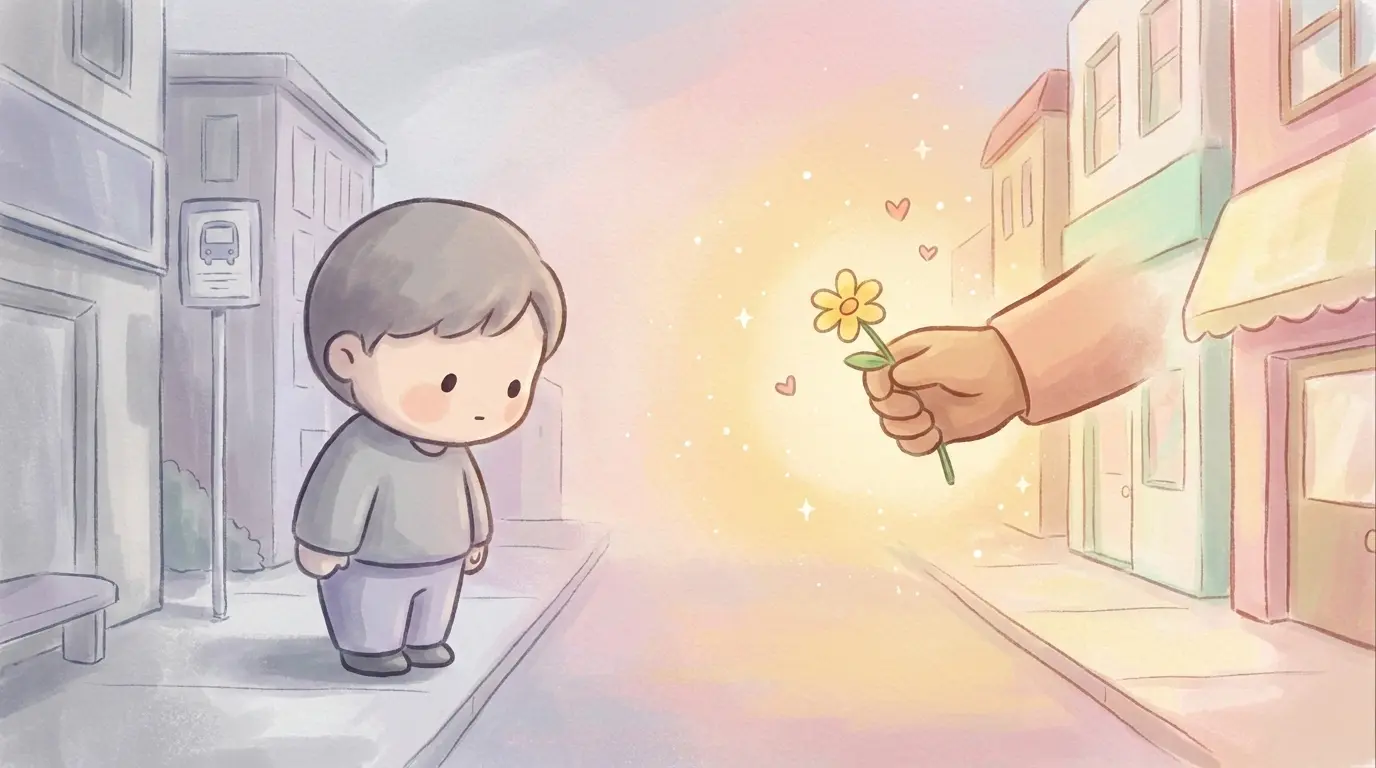
How a simple gesture can change your entire day
A message, a smile, or a hug triggers a chemical cascade in your brain that can change your whole day. Neuroscience explains why — and how you can be that gesture for someone.
There are days when you feel like you’re walking through the world invisible. When everything feels heavy, complicated, as if you were an extra in the movie of your own life. And then, out of nowhere, someone does something so simple that it reminds you that you exist, that you matter, that someone truly sees you.
It might be a message that arrives right when you need it. A genuine smile from a stranger in the elevator. A coffee your coworker brought you “just because.” Or that unexpected call from your sister asking how you’re doing, really.
When your brain lights up from the inside
Why do these moments impact us so much? Your brain literally lights up when someone shows you they care. It’s not just a figure of speech — neuroscience has measured it .
When you receive a genuine gesture, your body releases a cascade of oxytocin — the hormone that the Complutense University of Madrid describes as “the hug hormone.” Your cortisol drops, your blood pressure stabilizes, and that warm sensation you recognize as wellbeing appears. It’s no coincidence that after receiving that unexpected gesture you have more energy, see things differently, or feel like doing something kind for someone else.
Researchers at the University of Washington even discovered a specific neural circuit for pleasant touch: a neuropeptide called PROK2 that transmits the sensation of comforting contact from the skin to the brain. Your nervous system was tense, waiting, and suddenly someone presses the “everything is okay” button.
The new gestures of connection
In this era where we live glued to screens but sometimes feel more disconnected than ever, gestures have evolved. It’s no longer just the hug or the pat on the shoulder.
Now it can be:
- A WhatsApp voice note where your voice sounds warm and real, not just cold text
- A photo you took because “this reminded me of you”
- A meme you sent because you knew it would make them smile
- Staying 10 extra minutes on a video call just to hear how their day went
- Writing “I thought of you today” for no apparent reason, with no hidden agenda
- A playlist you put together thinking of that person
- Remembering a detail they mentioned weeks ago and asking how it went
A meta-analysis of 130 studies published in 2024 confirms that touch-based interventions significantly improve physical and mental wellbeing. But contact doesn’t have to be physical: what your brain is looking for is not just to be touched, but the confirmation that you exist for someone. An intentional message can activate the same social safety circuits as a hug.
The domino effect of kindness
The interesting thing about these gestures is that they multiply. When someone makes you feel seen, something inside you wants to do the same for another person.
Think about it: how many times have you had a horrible day that completely changed because of something someone did for you? And after that, didn’t you feel like being just as kind to someone else?
It’s not just good manners. Research on mirror neurons shows that when we observe or receive a kind gesture, the same areas of the brain that activate are the ones that push us to replicate that generosity. We’re wired to pass kindness from hand to hand.
"Positive social interactions generate higher levels of oxytocin, which in turn reduce stress markers and promote overall wellbeing.
The power is in your hands
Maybe while you’re reading this, someone comes to mind who could use that gesture today. That person you haven’t seen in a while. Your mom who’s always worried about everyone except herself. Your friend who’s going through a hard time. That coworker who’s been looking tired lately.
You don’t need much. You don’t need money, free time, or extra energy you don’t have. You just need to remember that we’re all humans walking through this world, sometimes feeling invisible, waiting for someone to remind us that we matter.
A message. A call. A smile. A hug. A “how are you?” said for real, waiting for the answer.
Because at the end of the day
We all need to know that someone thinks about us. And you have that power: to make someone feel that their day was worth it. To remind another person that they’re not alone. To create those small moments that, without exaggeration, can change the course of an entire day.
It’s not dramatic. It’s simply human. We’re made for connection, to take care of one another, to find meaning in the way we touch other people’s lives.
So if someone crossed your mind while you were reading this — that’s your sign.
Be that gesture for someone
A virtual hug might be exactly what someone needs today. Take 30 seconds.
Send a HugSources and References
Neuroscience of Oxytocin and Social Connection
- Complutense University of Madrid: “From breastfeeding to social bonds: this is how oxytocin works” — Research by Asunción López-Calderón Barreda on the “hug hormone.”
- Institute of Neurosciences (CSIC-UMH): Oxito-Cure Project — The oxytocinergic system as a therapeutic target.
- University of Antioquia: “The hormone oxytocin: neurophilosophy of the social and emotional life of human beings” — Uni-Pluriversidad, 2013.
Neuroscience of Touch and Wellbeing
- Psychology Today (2024): “The healing power of touch” — Meta-analysis of 130 studies on touch interventions (Packheiser et al.).
- Infobae / University of Washington: “The science behind pleasant touch” — Discovery of the neuropeptide PROK2 (Dr. Zhou-Feng Chen, Science).
Mirror Neurons and Gestural Communication
- Royal National Academy of Medicine: “Gestural communication: Theory of mind and mirror neurons” — Emilio García García, 2018.
Social Connection and Public Health
- La República: “The importance of social connection: how small gestures can combat loneliness”
- TSDifusion: “The centripetal force of social relationships: oxytocin” — Analysis from psychoneuroimmunoendocrinology.
You might also like

Despite Everything, Life Is Still Beautiful
Your brain is designed to absorb the bad and let the good slip by. But there is a way to reverse that — and it starts with the smallest moments.
Read more
The Science of Hugs: Human Touch Is Medicine
What happens to your body when someone hugs you for 20 seconds: oxytocin, cortisol, and why science says hugs are real medicine.
Read more